Final Major Project
Final Major Project
Project Proposal
These are some mood boards that i think will relate to form my project will take.
Initial Concepts
Overall I would like to attempt to make a dragon head but to create it properly I would have to own z brush or mud box which I do not own.

My second concept is to create a scene based in a historical period set in Japan during 17th and 18th century known as the Edo period. This concept is interesting because it houses many different ideas and I it's my favorite historical period.
Analysis Part 1
Japanese Culture
Japanese Armor
Armor in Japan has a history that goes back as far as the 4th century and has developed over the centuries since its introduction to the battlefield. Japanese armor was generally made from small iron or leather scales and plates connected to each other by rivets made of leather or braided silk and chain armor.
This armor would have been created by a skilled blacksmith and tailor.
The one of the colors in this armor are black which is a dark color,black is a mysterious color representing fear and unknowing this color could of been picked to strike fear into their foes.
The other color looks to be a shade of gold. Gold and black are appealing colors when used together.The color gold is associated with courage and wisdom.
A full suit of traditional Samurai armor could include the following items:
This research relates to my project because I am looking into Japanese history and armor was a key part of Japan's history.
Honda Tadakatsu (Samurai General)
Honda Tadakatsu was a Japanese Samurai general of the late Sengoku though early Edo periods.He was one of the Tokugawa Four Heavenly Kings (March 17 1548 - December 3 1610)
Tadakatsu is often referred to as "The Warrior who surpassed Death itself" because he never once suffered a significant wound, despite being the veteran of over 100 battles by the end of his life and because he was never defeated by another samurai. In theater and other contemporary works, Tadakatsu is often characterized as polar opposite of Ieyasu's other great general, Ii Naomasa. While both were fierce warriors of the Tokugawa, Tadakatsu's ability to elude injury is often contrasted with the common depiction of Naomasa enduring many battle wounds, but fighting through them
He served in all the major campaigns that led to Tokugawa Ieyasu's rise to power.
This is a Shinto shrine although they all tend to look different the one in this image is a small wooden building with a typical Japanese roof.
Shinto Funerals
Miyamairi
Miyamairi (shrine visit) is a traditional rite of passage in Japan for newborns one month after birth 31 days for boys and 33 for girls. Parents bring their child to a Shinto shrine, to express gratitude to the deities for the birth of a baby and have the shrine priest pray for the health and happiness of the baby. The practice is similar to christian infant baptism.
Amulets and Talismans
Omamori are Japanese amulets commonly sold at Shinto shrines and Buddhist temples, dedicated to particular Shinto kami as well as Buddhist figures, and are said to provide various forms of luck or protection.

Onna Bugeisha was a type of female warrior belonging to the Japanese nobility.Many women engaged in battle, commonly along side Samurai men.They were members of the Bushi (Samurai) class in federal Japan and were trained in the use of weapons to protect their household, family and honor in times of war.
Early History
Long before the emergence of the Samurai class, Japanese fighters were highly trained to wield a sword a spear.Women learned to use naginata,kaiken and the art of tantojutsu. Such training ensured protection in communities that lacked male fighters. One such woman,later known as Empress Jingu (169-269 AD) used her skills to inspire economic and social change.She was legendarily recognized as the onna bugeisha who led an invasion of Korea in 200 AD after her husband Emperor Chuai,the fourteenth emperor of Japan,was slain in battle.
According to legend,she miraculously led a Japanese conquest of Korea without shedding a drop of blood.Despite controversies surrounding her existence her accomplishments,she was an example of the onna bugiesha in its entirety.
Edo period and beyond
Because of the influence of Neo-Confucian philosophy and the established marriage market of the Edo period (1603-1868), the status of the onna bugeisha diminished significantly.The function of the onna bugeisha changed in addition to their husbands. Samurai were no longer concerned with battles and war,they were bureaucrats. Women,specifically daughter of most upper class households, were soon pawns to dreams of success and power.
Travel during the Edo period was demanding and unsettling for many female Samurai (because of heavy restrictions). They always had to be accompanied by a man,since they were not allowed to travel by themselves. Additionally,they had to possess specific permits,establishing their business and motives. Samurai women also received much harassment from officials who manned inspection checkpoints.
Films
The Last Samurai (Film)

Prometheus
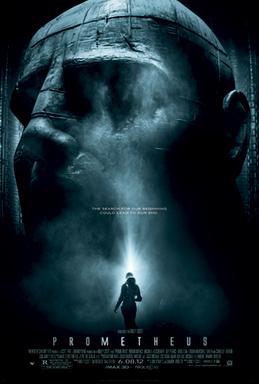
This film was released in June 1st 2012 in the UK
Directed by Ridley Scott
He also took on the job to direct the Alien film
The discovery of a clue to mankind's origins on Earth leads a team of explorers to the darkest parts of the universe.Two brilliant young scientists lead the expedition. Elizabeth Shaw hopes that they will meet a race of benevolent, godlike beings who in some way will verify her beliefs,While Holloway is out to debunk any spiritual notions.However,neither the scientist's nor their crew are prepared for the unimaginable terrors that await them.
A strong aspect of the film is the fact Ridley Scott used some 3D footage to increase the illusion of depth Despite this being his first 3D film he found the process easy. He said, "You can literally twiddle a knob and the depth will increase", and, "the trick is not to overdo it".
Another strong aspect of the film is the Prometheus ship itself to create it they researched NASA and the European space agency,spacecraft designs, and extended these concepts with his own ideas of how future space vehicles might look.

This film relates to our theme Terra-Incognita or Land Unseen and this film is about visiting a unknown alien planet.
Video Games

This is the video game Destiny developed by Bungie and published by Activision on September 9 2014
Bungie also created the game series Halo 2001-2010 till the developers changed to 343 industries and they later produced Halo 4 and Halo 5 2014-2015
A strong element of Destiny's design is that the game space is classed as a "shared world" game which in definition continues to exist and develop internally even when there are no people interacting with it. but the term is frequently used in relation to MMORPG (massively multiplayer online role-playing games).
Another strong element of Destiny's design is that Bungie's textures are high quality and their models are flawless and look great especially the weapons they make.
This relates to my project because if I decide to create a weapon it would be used inside the Destiny universe.
Another design feature of Skyrim is that the game is open world games like these will typically lack the use of invisible barriers and loading screens common in linear level designs.Open world games are designed to be nonlinear meaning many there are many open areas with many ways to reach an objective instead of going though a door and reaching the next level.

This relates to my project because Skyrim's plot is based around Dragons.

Project Proposal
Review (150 Words)
|
In previous projects a lot of my favorite games have
influenced my work as well as looking on art station and taking ideas from
there and implementing them in my own work.
In my previous projects I have made a lot of storage
devices and have learnt how they should work and to be careful when texturing
difficult shapes.
Throughout my time at bmet I have learnt a lot about 3D
modelling and developed my skills along the way especially with UV unwrapping
and even using my sketchbook to give me a basis for a concept/idea and to plan how it should look.
I have learnt almost everything I know from my tutors at
bmet and other things from Google and YouTube and will take everything I have
learnt to other companies and develop on these skills and hopefully make a
living from doing what I love and what I will continue to love for the rest
of my life.
|
Project Concept (250 Words)
|
Our project’s theme is Terra Incognita (Terra-Land.
Territory Incognita-Unknown, Unseen)
My inspiration will come a lot from game developers and
their concept artists/game artists and the different games they have created
using different art styles and even people who post their work on art station
inspire me to be as good as they are.I may look into Japanese culture
especially during the Edo period and fantasy creatures, possibly dragons. A
third concept could involve alien weaponry.
I will also be inspired by myself and create a project
that inspires and interests me so I want to work harder on it and push
myself to create it the best I can. I am also inspired by the real world and
how technology is growing and how rapidly it’s changing our world and what’s
around me and how it’s changing.
I intend to make a 3D piece of art that could either be a
scene, character or asset.
I will use all the skills I have and will push them to the
limits to get the best out of myself. I will mainly focus on my sketching and
improve it as my concepts develop further. I will use my UV unwrapping skills
and try to work around previous mistakes so that I notice them sooner and fix them or try to avoid them completely by using different
techniques.
My audience will be other 3D modelers who are interested
in looking at other work but mainly my audience will be companies in the game
industry to get a job with them.
|
Evaluation (100 Words)
|
I will critically analyse my work using the formal
elements and explain how they are used in my work. Also by explaining what I
like and dislike about my work and what went well and how I could improve it.
I will identify directions for ongoing developments by
explaining how I want it to look or work and how I will make it do that and
what errors I could run into along the way. We will also do a lot of peer
assessments and tutorials with our tutor.
I will record critical responses and developments by
typing them up on my blog.
I will organise my time by creating a time plan that I
will try to follow to make sure I finish before or right on the deadline.
|
Time Plan
This is my time plan for the project some things will change because I may need more or less time on certain tasks.Looking at this I may have planed that I finish the starting tasks way to early and I have given myself too much time to focus on the final piece leaving myself this much time could mean I finish it way to early and have nothing to do and my research tasks may not be to the same level as my final piece inevitably letting my overall grade down.
Mind Map

------------------------
------------
|
Aims for the week
|
Estimated Time Taken
|
Rollover (Continue working on it next week)
Y/N (What’s left to do.)
|
Completed
Y/N
|
Week 1
|
Project Proposal
Time Plan
Mind-Map
Mood boards
Initial Sketches
|
1 Hour
1 Hour
30-45 Minutes
1 Hour
2- 2.5 Hours
|
N
N N N
Y (Create another concept)
|
Y
Y
Y
Y
Y
|
Week 2
|
Task 3 P1
Task 3 P2
Task 4
|
3-4 Hours
2-3 Hours
4 Hours
|
N
N
N
|
|
Week 3
|
Task 4
Task 5
|
2-3 Hours
Rest of the week
|
N
N
|
|
Week 4
|
Task 5
|
3-4 Hours
|
N
|
|
Week 5
|
Task 6
|
Whole Week
|
N
|
|
Week 6
|
Task 6
|
Whole Week
|
N
|
|
Week 7
|
Task 6
|
Whole Week
|
N
|
|
Week 8
|
Task 6
|
Whole Week
|
N
|
|
Week 9
|
Task 6
|
Whole Week
|
N
|
|
Week 10
|
Task 6
|
Whole Week
|
N
|
|
Week 11
|
Task 6
|
Whole Week
|
N
|
|
Week 12
|
Task 6
|
Whole Week
|
N
|
|
Week 13
|
Task 6
|
Whole Week
|
N
|
|
Week 14
|
Task 6
|
Whole Week
|
N
|
|
Week 15
|
Task 6
|
Whole Week
|
N
|
|
Week 16
Deadline 7th June |
Evaluation
|
Whole Week
|
N
|
Mind Map

Mood Boards
 |
| Metal I have included this because metal is a universal material and can be used to make almost anything such as household objects and buildings and most of my previous projects have used a type of metal. |
 |
| Perspective I have included perspective because it is one of an artist greatest tools a experienced artist can use perspective to manipulate objects and characters how they like.I suffer from lack of perspective and therefore my drawings look simple and flat. |
 |
| Landscapes are everywhere especially inside games and a thing I love to do inside of games is explore the landscape around me to look for a vantage point if against enemies or just to find new weapons and quests or even Easter eggs. |
 |
| Edo Period (1603-1868) I have included this as a mood board because it is one of my favorite historical periods and it shows the Samurai at the top of the food chain and the weapons they hold being a symbol of power allowing them to cut down any "commoner" who disrespected them. |
Initial Concepts
 |
| This concept is to model a dragon head which would be a great challenge because I've never tried modeling anything organic or even a character. |
 |
| This is another Head shape but with the mouth open and I decided to colour it blue because its a overlooked color and I don't see many blue dragons inside of games and if i was to model and texture one it would be blue. |
Overall I would like to attempt to make a dragon head but to create it properly I would have to own z brush or mud box which I do not own.

My second concept is to create a scene based in a historical period set in Japan during 17th and 18th century known as the Edo period. This concept is interesting because it houses many different ideas and I it's my favorite historical period.
 |
| This concept is a rifle that instead of killing enemies it is used to shield allies. I really like this concept because I've always wanted to create some sort of rifle but not make it a weapon. |
 |
| These are all of the forms it could take instead of being a rifle. |
 |
| Because this weapon origins are unknown I decided to play around with the shape and make it unique. I have labeled this as a "final design" but this will not be the final outcome,it may change. |
Analysis Part 1
Japanese Culture
Japanese Armor
Armor in Japan has a history that goes back as far as the 4th century and has developed over the centuries since its introduction to the battlefield. Japanese armor was generally made from small iron or leather scales and plates connected to each other by rivets made of leather or braided silk and chain armor.
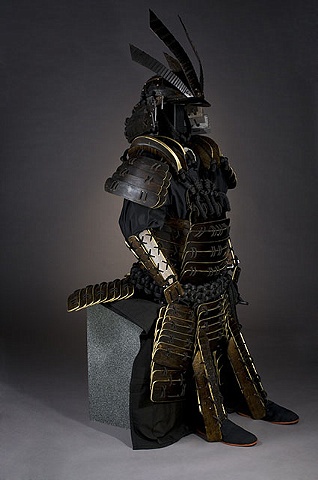 |
| This is a set of Edo period Samurai armor. |
This armor would have been created by a skilled blacksmith and tailor.
The one of the colors in this armor are black which is a dark color,black is a mysterious color representing fear and unknowing this color could of been picked to strike fear into their foes.
The other color looks to be a shade of gold. Gold and black are appealing colors when used together.The color gold is associated with courage and wisdom.
A full suit of traditional Samurai armor could include the following items:
Dou a chest armor made up of iron and or leather
plates of various sizes and shapes with pendents
Kusazuri made from iron or leather plates hanging from the
front and back of the dou to protect the lower body and upper leg.
Sode, large rectangular shoulder protection made from iron
and or leather plates.
Kote, armored glove like sleeves which extended to the
shoulder or han kote which covered the forearms. Kote were
made from cloth covered with iron plates of various size and shapes, connected
by chain armor
Kabuto, a helmet made from iron or leather plates,from 3 to
over 100 plates,riveted together. A neck guard shikoro made from several
layers of curved iron or leather strips was suspended from the bottom edge of
the kabuto.
Mengu, various types of lacquered metal and or leather
facial armor designed in a way that the top heavy helmet kabuto could be tied
and secured to them by various metal posts. Mengu had throat guards yodare-kake
made from several rows of iron or leather plates or kusari (chain armor) sewn
to a cloth backing, suspended from the bottom edge.
Haidate, thigh guards which tied around the waist and
covered the thighs. These were made from cloth with small iron and or leather
plates of various size and shape, usually connected to each other by chain
armor and sewn to the cloth.
Suneate, shin guards made from iron splints connected
together by chain armor and sewn to cloth and tied around the calf.
This research relates to my project because I am looking into Japanese history and armor was a key part of Japan's history.
Honda Tadakatsu (Samurai General)
Honda Tadakatsu was a Japanese Samurai general of the late Sengoku though early Edo periods.He was one of the Tokugawa Four Heavenly Kings (March 17 1548 - December 3 1610)
 |
| This is a statue of Honda Tadakatsu |
Tadakatsu is often referred to as "The Warrior who surpassed Death itself" because he never once suffered a significant wound, despite being the veteran of over 100 battles by the end of his life and because he was never defeated by another samurai. In theater and other contemporary works, Tadakatsu is often characterized as polar opposite of Ieyasu's other great general, Ii Naomasa. While both were fierce warriors of the Tokugawa, Tadakatsu's ability to elude injury is often contrasted with the common depiction of Naomasa enduring many battle wounds, but fighting through them
He served in all the major campaigns that led to Tokugawa Ieyasu's rise to power.
Tadakatsu seems to have been a colorful figure, around whom
a few legends have sprung up - it is often said that of all the battles in
which he served, he never once received a wound. His helmet, famously adorned
with deer antlers, ensured that he was always a recognizable figure on the
field of battle. His horse was known as Mikuniguro. His spear was named
Tonbo-Giri, or Dragonfly Cutter, because legend held that the tip of the spear
was so sharp that a dragonfly that landed on it was cut in two. His fighting
prowess with it was so great that it became known as one of the "Three
Great Spears of Japan". Aside from this incredible spear, Tadakatsu also
used the katana Nakatsukasa Masamune, a 67 cm blade, another national treasure
of Japan. Thus, it can be said Tadakatsu was among the best equipped military
commanders of his time.

Tadakatsu was allegedly praised by Oda Nobunaga as "a
true samurai, both inside and out" and by Toyotomi Hideyoshi as "a
hero unsurpassed in all of history"
Shintoism (Religion)
Shinto is the traditional religion of Japan focusing on ritual practices to be carried out diligently to establish a connection between present day Japan and it's ancient past.
Shinto Practices were first recorded in the 8th century these earliest Japanese writings do not refer to a unified religion but rather a collection of native beliefs and mythology
The word Shinto (way of the gods) was adopted as Jindo or Shindo from the written Chinese Shendao
80% of the population in Japan participates in Shinto rituals but only a small percentage identify themselves as "Shintoists" this is because Shinto has many different meanings in Japan.There are 81,000 shrines and 85,000 priests of Shinto in the country.

Shinto Practices were first recorded in the 8th century these earliest Japanese writings do not refer to a unified religion but rather a collection of native beliefs and mythology
The word Shinto (way of the gods) was adopted as Jindo or Shindo from the written Chinese Shendao
80% of the population in Japan participates in Shinto rituals but only a small percentage identify themselves as "Shintoists" this is because Shinto has many different meanings in Japan.There are 81,000 shrines and 85,000 priests of Shinto in the country.
This is a Shinto shrine although they all tend to look different the one in this image is a small wooden building with a typical Japanese roof.
Shinto Funerals
Shinto Funerals were established during the Tokugawa period
and focused on two themes:concern for the fate of the corpse, and maintenance
of the relationship between the living and the dead. There are at least twenty
steps involved in burying the dead. Mourners wear solid black in a day of
mourning called Kichu-fuda and a Shinto priest will perform various rituals.
People will give monetary gifts to the deceased's family called Koden, and Kotsuge
is the gathering of the deceased's ashes. Some of the ashes are taken by family
members to put in their home shrines at the step known as Bunkotsu
Miyamairi
Miyamairi (shrine visit) is a traditional rite of passage in Japan for newborns one month after birth 31 days for boys and 33 for girls. Parents bring their child to a Shinto shrine, to express gratitude to the deities for the birth of a baby and have the shrine priest pray for the health and happiness of the baby. The practice is similar to christian infant baptism.
Amulets and Talismans
Omamori are Japanese amulets commonly sold at Shinto shrines and Buddhist temples, dedicated to particular Shinto kami as well as Buddhist figures, and are said to provide various forms of luck or protection.
 |
| This is an image of different amulets forms and talisman shapes. |
Onna-bugeisha (Female Martial Artist)
Onna Bugeisha was a type of female warrior belonging to the Japanese nobility.Many women engaged in battle, commonly along side Samurai men.They were members of the Bushi (Samurai) class in federal Japan and were trained in the use of weapons to protect their household, family and honor in times of war.
Early History
Long before the emergence of the Samurai class, Japanese fighters were highly trained to wield a sword a spear.Women learned to use naginata,kaiken and the art of tantojutsu. Such training ensured protection in communities that lacked male fighters. One such woman,later known as Empress Jingu (169-269 AD) used her skills to inspire economic and social change.She was legendarily recognized as the onna bugeisha who led an invasion of Korea in 200 AD after her husband Emperor Chuai,the fourteenth emperor of Japan,was slain in battle.
| A tanto used to preform tantojutsu |
According to legend,she miraculously led a Japanese conquest of Korea without shedding a drop of blood.Despite controversies surrounding her existence her accomplishments,she was an example of the onna bugiesha in its entirety.
Edo period and beyond
Because of the influence of Neo-Confucian philosophy and the established marriage market of the Edo period (1603-1868), the status of the onna bugeisha diminished significantly.The function of the onna bugeisha changed in addition to their husbands. Samurai were no longer concerned with battles and war,they were bureaucrats. Women,specifically daughter of most upper class households, were soon pawns to dreams of success and power.
Travel during the Edo period was demanding and unsettling for many female Samurai (because of heavy restrictions). They always had to be accompanied by a man,since they were not allowed to travel by themselves. Additionally,they had to possess specific permits,establishing their business and motives. Samurai women also received much harassment from officials who manned inspection checkpoints.
The onset of the 17th century marked a significant
transformation in the social acceptance of women in Japan. Many samurai viewed
women purely as child bearers; the concept of a woman being a fit companion for
war was no longer conceivable
Films
The Last Samurai (Film)
This is a film that was released in the US on December 5 2003.
Directed by Edward Zwick.
Edward Zwick also helped make Blood Diamond (2006) and Glory (1989)
A Strong aspect of this film is the films soundtrack that was composed arranged and produced by Hans Zimmer, Performed by the Hollywood studio symphony and conducted by Blake Neely. It peaked at number 24 on the US top soundtracks chart and was a great soundtrack to go along with a great film.
Another strong aspect of this film is the stunning scenes they are absolutely amazing here is an example

The view in this scene is amazing all the luscious green scenery and the tall mountains look stunning.
The films plot is inspired by the 1877 Satsuma Rebellion which was a real historical event and someone interested in that time period will want to watch this film.
Directed by Edward Zwick.
Edward Zwick also helped make Blood Diamond (2006) and Glory (1989)
Tom Cruise portrays a United States Captain of the 7th
Cavalry Regiment, whose personal and emotional conflicts bring him into contact
with Samurai warriors in the wake of the Meiji Restoration in 19th Century
Japan. The film's plot was inspired by the 1877 Satsuma Rebellion led by Saigo Takamori, and the westernization of Japan by foreign powers.
A Strong aspect of this film is the films soundtrack that was composed arranged and produced by Hans Zimmer, Performed by the Hollywood studio symphony and conducted by Blake Neely. It peaked at number 24 on the US top soundtracks chart and was a great soundtrack to go along with a great film.
Another strong aspect of this film is the stunning scenes they are absolutely amazing here is an example
The view in this scene is amazing all the luscious green scenery and the tall mountains look stunning.
The films plot is inspired by the 1877 Satsuma Rebellion which was a real historical event and someone interested in that time period will want to watch this film.
This film relates to my final major because it's based around the Edo period which I am interested in because It's my favourite time period and the samurai are amazing.
Prometheus
This film was released in June 1st 2012 in the UK
Directed by Ridley Scott
He also took on the job to direct the Alien film
The discovery of a clue to mankind's origins on Earth leads a team of explorers to the darkest parts of the universe.Two brilliant young scientists lead the expedition. Elizabeth Shaw hopes that they will meet a race of benevolent, godlike beings who in some way will verify her beliefs,While Holloway is out to debunk any spiritual notions.However,neither the scientist's nor their crew are prepared for the unimaginable terrors that await them.
A strong aspect of the film is the fact Ridley Scott used some 3D footage to increase the illusion of depth Despite this being his first 3D film he found the process easy. He said, "You can literally twiddle a knob and the depth will increase", and, "the trick is not to overdo it".
Another strong aspect of the film is the Prometheus ship itself to create it they researched NASA and the European space agency,spacecraft designs, and extended these concepts with his own ideas of how future space vehicles might look.
This film relates to our theme Terra-Incognita or Land Unseen and this film is about visiting a unknown alien planet.
Video Games
Destiny (Game)
This is the video game Destiny developed by Bungie and published by Activision on September 9 2014
Bungie also created the game series Halo 2001-2010 till the developers changed to 343 industries and they later produced Halo 4 and Halo 5 2014-2015
A strong element of Destiny's design is that the game space is classed as a "shared world" game which in definition continues to exist and develop internally even when there are no people interacting with it. but the term is frequently used in relation to MMORPG (massively multiplayer online role-playing games).
 |
| This is a group of players taking on a Fallen Walker in a patrol where you can see other players so these people most likely don't know each other but are playing the game together and helping each other. |
Another strong element of Destiny's design is that Bungie's textures are high quality and their models are flawless and look great especially the weapons they make.
 |
| This is an exotic rifle inside of the game called Red Death and it looks stunning. |
Skyrim (Game)

This is a video game created by Bethesda and the initial release date was 11th November 2011
Bethesda have also developed Fallout 4 (2015) and Doom (2016)
A strong aspect of Skyrim is that the player can decide either to play in a first person perspective of their character or a third person perspective of their character.With a simple press of a button the player can change from each perspective.This gives the player more freedom towards their game play.

Bethesda have also developed Fallout 4 (2015) and Doom (2016)
A strong aspect of Skyrim is that the player can decide either to play in a first person perspective of their character or a third person perspective of their character.With a simple press of a button the player can change from each perspective.This gives the player more freedom towards their game play.
Another design feature of Skyrim is that the game is open world games like these will typically lack the use of invisible barriers and loading screens common in linear level designs.Open world games are designed to be nonlinear meaning many there are many open areas with many ways to reach an objective instead of going though a door and reaching the next level.
This relates to my project because Skyrim's plot is based around Dragons.
For Honor
This is a video game developed by Ubisoft Montreal and was released on the 14th February 2017,created in the Anvil engine.
A strong aspect of this game is it's realistic fighting mechanics making you have to push the analog stick to block the way your enemy is attacking and if they heavy attack you can parry it by heavy attacking at the right time in the direction they are attacking if done correctly and timed perfectly your character will parry your enemy causing them to be stunned and open for attack, if it's timed wrong you will just try to heavy attack your opponent but their attack will hit first damaging you and stopping you from attacking consecutively.
Another strong aspect to For Honor is it's diverse character section there are 3 factions in the game Knights,Vikings and Samurai each have a decent amount of characters to select from allowing a player can become very efficient with one character however even though you may be great with your certain class there are counters to your character which can be diminishing if your enemies know your who your going to pick every time.
This game relates to my research about Japanese culture because it contains the Samurai faction.
A strong aspect of this game is it's realistic fighting mechanics making you have to push the analog stick to block the way your enemy is attacking and if they heavy attack you can parry it by heavy attacking at the right time in the direction they are attacking if done correctly and timed perfectly your character will parry your enemy causing them to be stunned and open for attack, if it's timed wrong you will just try to heavy attack your opponent but their attack will hit first damaging you and stopping you from attacking consecutively.
Another strong aspect to For Honor is it's diverse character section there are 3 factions in the game Knights,Vikings and Samurai each have a decent amount of characters to select from allowing a player can become very efficient with one character however even though you may be great with your certain class there are counters to your character which can be diminishing if your enemies know your who your going to pick every time.
 |
| Samurai faction. |
This game relates to my research about Japanese culture because it contains the Samurai faction.
Revisiting Concepts
For this task I will go back and revisit my concepts rework them if needed and add more detail
Digital Concepts
I am going to create a digital concept for my project using Photoshop.
Modelling Final Piece
From this point on I am going to devote all my time to modelling and texturing my final piece.There are alot of variables when creating my final piece.Along the way I could find certain things about my design that I dislike and decide to change.I could discover some issues when modelling such as topology issues.
Helmet
Evaluation
When I first saw the brief I instantly thought of the past as lots of our past has been forgotten. My initial concepts were to create a weapon found on an unknown planet that could heal allies and apply shields to them I really liked this concept as I would like to create a weapon but have it not harm people.My second concept was to create a dragon head as they are in lots of mythology and no one is sure if they actually existed. My last concept was based around the Edo period of Japan 1603-1868 and was mainly to create a scene but as I developed my concept I thought of creating a set of Samurai armour.
I developed my Japan concept because I am highly interested in the past and adore the Edo period.Over the course of this project I have researched into Japanese armour, the Shinto religion, female martial artist during the Edo period and films/games that interest me.To develop my concepts I have used a lot of sketching which at first I was hesitant to do because I am not a strong drawer but as I developed my concepts my drawing skills improved an by the end I really enjoyed sketching concepts.
I found some aspects of my model hard to create such as the Kabuki that was the most challenging because I had to use a technique I was not familiar with but in the end I enjoyed it and the final product came out great.
Good points
I think the best looking asset of my project has to be the helmet.I think it looks awesome and I am very happy with how it makes the whole piece look.
The colours I have chosen are red and gold as you can see. I chose gold because I wanted to make it look intricate and ornate and gold does it well. I chose red because red is associated with blood and strength,the samurai were know for both of those.
The emblem on the chest is the symbol for Raijin the god of thunder and lightning.I think it looks great and adds depth and meaning to my piece by relating to the Shinto religion.
Improvements
The shoulder pads are not exactly how I wanted them to come out and I could of gone back and re-designed them and made two completely different ones.
Originally I wanted to use black metal instead of red but I could not get it too work so I gave up when I could of researched into why and how to make it look better.
I like the ornament placed on top of the helmet,originally I was going for a ornament with two blades coming off each side at an angel but when I happened to create this I really liked it and kept it.
I could of added tiny little details such as rivets in the armour and/or war scars to the face or armour.
Overall I am very proud of my final piece and I believe it looks exactly how it should and looks like a set of Samurai armour which was my goal, but to also make it my own and I have done that.
For this task I will go back and revisit my concepts rework them if needed and add more detail
 |
| These are a sketches of different types of ornaments that can be used on my helmet my favourite is the dragon heads because the shape is so unusual and I adore it. |
 |
| Samurai Side view torso and head holding a Wakizashi. This pose was simple enough to create but I had to make sure the head wouldn't be too big or too small.although the sword does look a little small and to bendy. |
 |
| Samurai Side view full body holding katana. this was my first go at creating a full body pose I found the proportions tricky to match up. |
 |
| Samurai lent against a wall this is my best one yet because it shows more perspective as an artist I find drawing in perspective difficult and I'm not sure why but I still try and practice,doing this has proved that I am improving. The most difficult part about this drawing was trying to get the proportions right whilst still thinking about the perspective and my proportions are still a little off. |
 |
| This sketch is by far my favorite because the pose looks more aggressive than the previous one and that's how I wanted it too look. To create this pose was a lot harder than any pose I've tried before because there's so much to pay attention to and make sure everything looks right. The hardest part was to make sure the hand was the correct size and It took a few tries to get it right. I thoroughly enjoyed sketching this piece and will continue to develop on my drawing skills. |
 |
| I decided to shade this sketch and I think it turned out great |
Digital Concepts
I am going to create a digital concept for my project using Photoshop.
 |
| I took my favorite sketch and decided to paint it inside of Photoshop.I am very pleased with how it came out the hardest part in my opinion was make sure all the lines were smooth and to do that I used the polygonal lasso tool to select the edges and either erase or paint to create a smooth edge. I didn't decide to put any outlines because I thought It would look better without. |
Modelling Final Piece
From this point on I am going to devote all my time to modelling and texturing my final piece.There are alot of variables when creating my final piece.Along the way I could find certain things about my design that I dislike and decide to change.I could discover some issues when modelling such as topology issues.
 |
| To create the face mask known as a kabuki I will use the plane modelling technique |
 |
| Following around the outside to get an idea of the outline I need. |
 |
| I am going to go down to the left side of the chin because I only need to create half of the mask and then I will use the symmetry modifier. |
 |
| Plane modelling finished. |
 |
| This is how it looks I am going to use the turbo smooth modifier. |
 |
| This is how it looks with turbo smooth I am going to create the mouth part now. |
 |
| This is the finished product I am really happy with how it came out considering I haven't used plane modelling much. |
Helmet
 |
| I decided to start with a cylinder. |
 |
| Using bevel and extrude to create a helmet shape. |
 |
| This will be where the ornament will sit. |
 |
| Creating a ornament shape via extruding. |
 |
| Start of the ornament shape. |
 |
| I really like the look of this ornament so i will keep it. |
 |
| creating the shape to sit on the shoulder of the bust. |
 |
| This is the completed helmet with turbo smooth on it. I am really pleased with how this came out I think it defiantly looks like a samurai helmet. |
 |
| This is a render of the helmet and kabuki alone. |
 |
| This is my final render I think it looks amazing.I have applied an ambient occlusion render on top of it this adds more depth and separates the light and dark places therefore adding greater detail. |
Evaluation
When I first saw the brief I instantly thought of the past as lots of our past has been forgotten. My initial concepts were to create a weapon found on an unknown planet that could heal allies and apply shields to them I really liked this concept as I would like to create a weapon but have it not harm people.My second concept was to create a dragon head as they are in lots of mythology and no one is sure if they actually existed. My last concept was based around the Edo period of Japan 1603-1868 and was mainly to create a scene but as I developed my concept I thought of creating a set of Samurai armour.
I developed my Japan concept because I am highly interested in the past and adore the Edo period.Over the course of this project I have researched into Japanese armour, the Shinto religion, female martial artist during the Edo period and films/games that interest me.To develop my concepts I have used a lot of sketching which at first I was hesitant to do because I am not a strong drawer but as I developed my concepts my drawing skills improved an by the end I really enjoyed sketching concepts.
I found some aspects of my model hard to create such as the Kabuki that was the most challenging because I had to use a technique I was not familiar with but in the end I enjoyed it and the final product came out great.
Good points
I think the best looking asset of my project has to be the helmet.I think it looks awesome and I am very happy with how it makes the whole piece look.
The colours I have chosen are red and gold as you can see. I chose gold because I wanted to make it look intricate and ornate and gold does it well. I chose red because red is associated with blood and strength,the samurai were know for both of those.
The emblem on the chest is the symbol for Raijin the god of thunder and lightning.I think it looks great and adds depth and meaning to my piece by relating to the Shinto religion.
Improvements
The shoulder pads are not exactly how I wanted them to come out and I could of gone back and re-designed them and made two completely different ones.
Originally I wanted to use black metal instead of red but I could not get it too work so I gave up when I could of researched into why and how to make it look better.
I like the ornament placed on top of the helmet,originally I was going for a ornament with two blades coming off each side at an angel but when I happened to create this I really liked it and kept it.
I could of added tiny little details such as rivets in the armour and/or war scars to the face or armour.
Overall I am very proud of my final piece and I believe it looks exactly how it should and looks like a set of Samurai armour which was my goal, but to also make it my own and I have done that.
Comments
Post a Comment